


If you’ve ever picked up a fish oil supplement and squinted at the label, wondering aloud, “What is EPA and DHA?” you’re in good company. Both are found in fish oil and support heart health, and they’re usually taken together. But they’re not the same thing, and understanding EPA vs. DHA differences can help you choose the right supplement for your health goals.
What are EPA and DHA?
EPA stands for eicosapentaenoic acid, and DHA stands for docosahexaenoic acid. We know those are overwhelming names, but the abbreviations are what matter.
Both are long-chain omega-3 fatty acids, which are healthy fats your body needs but can’t produce enough of on its own. In simpler terms, your body takes them in and puts them to work in different ways depending on what it needs.
What EPA does
EPA is primarily an anti-inflammatory fatty acid. The body uses it to help regulate the immune system and keep inflammation in check. It’s also the omega-3 most strongly associated with heart health and mood support. Additionally, research suggests it plays a distinct role in how the body manages chronic, low-grade inflammation¹. The anti-inflammatory properties also may help manage joint pain2.
Access to EPA is simple, and often delicious. Good dietary sources of EPA include fatty fish, like salmon, sardines, mackerel, and anchovies. If you aren’t a seafood person, you can still get what you need from omega-3 supplements.
What DHA does
DHA is structural, meaning the body uses it as a physical building material. For instance, a significant portion of your brain and the retina of your eye is made of DHA3.
DHA is especially critical during fetal development and early childhood, when the brain and nervous system are growing rapidly4. As such, it’s the omega-3 most associated with cognitive function and eye health across all life stages.
Finally, the same fatty fish that supply EPA also supply DHA. Algae is another source, and it’s where fish get their DHA.
What about ALA?
You may have seen ALA on plant-based omega-3 labels. It comes from flaxseed, chia, and walnuts. Your body can convert it into EPA/DHA, but only a small fraction (up to about 8%) makes it through that process5. While some people swear by ALA, it’s not a reliable substitute for getting EPA and DHA directly from fish or algae.
How much EPA and DHA do you need?
There’s no universal answer, because needs vary based on age, health status, wellness goals, and other factors.
Luckily, there are some useful benchmarks.
The general guidance from health organizations averages around 250 to 500 mg of combined EPA and DHA per day for healthy adults6. For people focused on triglyceride management, clinical research supports higher amounts—around 3,000 to 4,000 mg daily—as part of a healthy diet and exercise routine7. Most people fall well short of these targets through diet alone.
EPA and DHA during pregnancy
DHA needs increase significantly during pregnancy, particularly in the third trimester, when fetal brain development accelerates. Requirements can jump from around 300 to 600 mg of DHA daily, up to 900 mg or more4. EPA matters too, both for the mother’s cardiovascular and mood support and for overall omega-3 balance.
OmegaVia’s Prenatal DHA delivers 600 mg of algae-based DHA per softgel, making it a clean, fish-free option for pregnant and nursing mothers.
Women who want additional EPA alongside their prenatal DHA can add EPA 500 to their routine, though it should always be paired with a separate DHA supplement during pregnancy, as EPA 500 alone does not meet DHA requirements.
EPA and DHA for children
Both can help support the needs of growing children, particularly DHA for brain and eye development. OmegaVia’s Kid’s Omega-3 Chewies are suitable for children 3 and older. They have a pleasantly sweet taste while remaining 100% sugar-free. Swallowing pills can be tricky for younger kids; opting for chewies instead eliminates this problem. Find dosage guidance on the product page.
Choosing the right OmegaVia formula
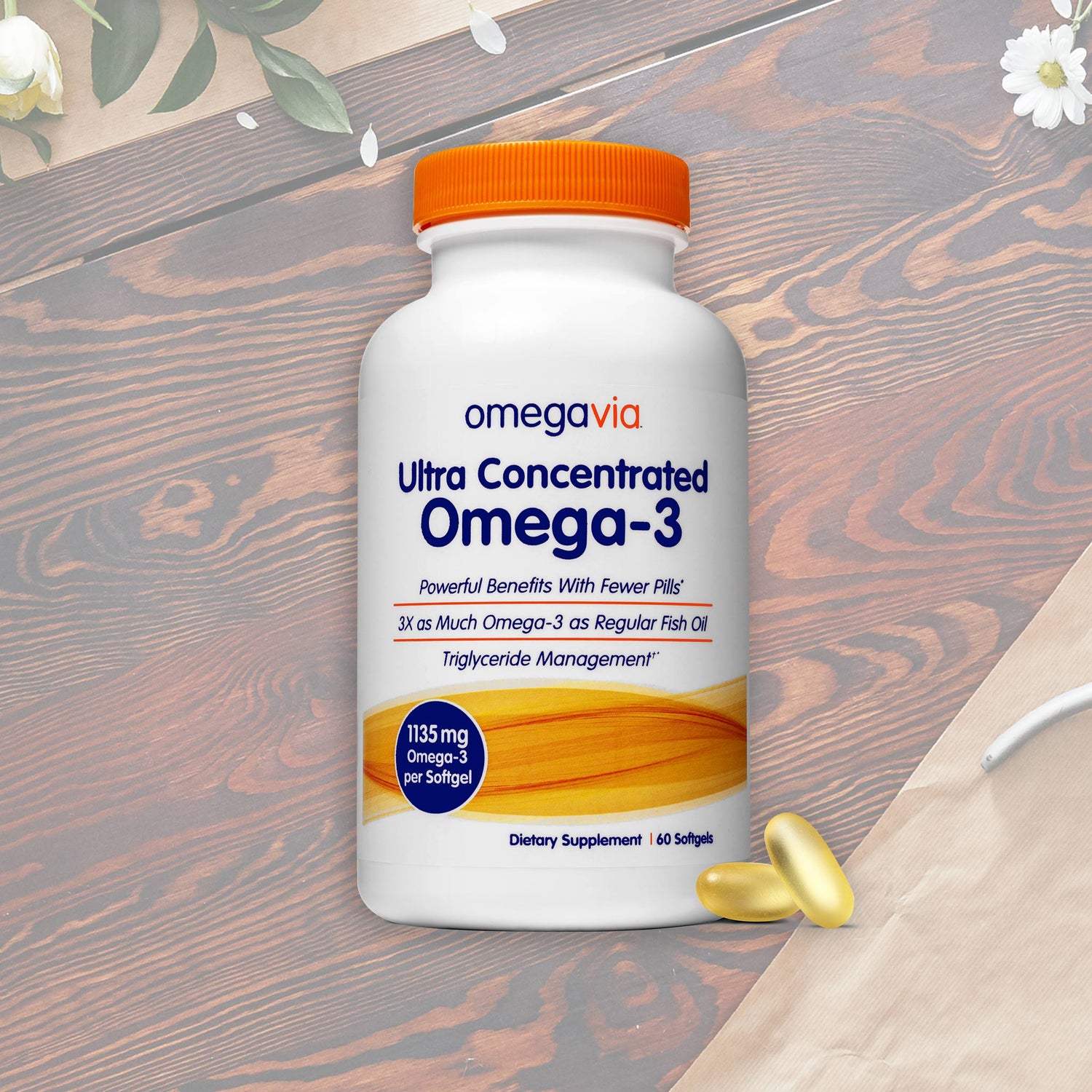
Ultra Concentrated Omega-3 delivers 1,135 mg of EPA and DHA per softgel. Three softgels put adults within the range most studied for triglyceride and heart health support.
For those focused specifically on EPA’s role in mood and cardiovascular function, OmegaVia’s EPA 500 supplement provides 500 mg of pure EPA per softgel with only trace amounts of DHA.
All OmegaVia formulas are triple-purified, third-party tested by IFOS and ConsumerLab, and sourced from wild, small fish off the coasts of Peru and Chile.
Frequently asked questions
What is the difference between EPA and DHA?
Both are omega-3 fatty acids found in fish oil, but they work differently in the body. EPA is primarily anti-inflammatory and is most associated with heart, mood, and joint support. DHA is a structural fat, physically built into brain tissue, the retina, and cell membranes.
Most fish oil supplements contain both, but the ratio varies, and some formulas isolate one or the other for more targeted use.
Is more DHA or EPA better for inflammation?
Research from the Jean Mayer USDA Human Nutrition Research Center at Tufts University found that DHA had a stronger effect on reducing pro-inflammatory proteins, lowering the expression of four types compared to EPA’s one1.
However, EPA was better at improving the balance between pro- and anti-inflammatory proteins, which matters for long-term cardiovascular health. The practical takeaway: Both contribute to managing inflammation, just through different mechanisms. For most people, getting both is the right call.
Do I need both EPA and DHA in my fish oil?
To support general health, yes. The two fatty acids complement each other, and most research supporting omega-3 benefits has studied them together. That said, there are cases where targeting one makes sense.
People focused on mood support may benefit from a higher-EPA formula. Pregnant women specifically need to ensure adequate DHA. And some people with high triglycerides may use high-dose EPA under medical supervision.
If you’re not sure where to begin, starting with a balanced formula is reasonable.
What is the best EPA to DHA ratio in a supplement?
Most standard fish oil supplements deliver roughly a 3:2 ratio of EPA/DHA, which is a reasonable starting point. Some research suggests that a higher EPA ratio may be preferable for mood and cardiovascular support, while higher DHA ratios are more relevant during pregnancy and for brain health. There’s no one-size-fits-all ratio. The right amount depends on whether you’re getting enough total omega-3 in a form your body can absorb, which is where concentration and form (triglyceride vs. ethyl ester) matter more than the ratio alone.
Is EPA or DHA better for mood and brain health?
EPA has a better evidence base for mood support. That said, some research indicates that formulas with at least 60% EPA may be more effective for that purpose.
DHA, on the other hand, is the dominant structural fat in the brain and is most closely associated with various brain functions.
For brain health broadly defined, DHA is foundational. For mood specifically, EPA tends to get more attention in the research. For most people, a supplement that delivers a meaningful amount of both is the practical answer.
These statements have not been evaluated by the Food and Drug Administration. This product is not intended to diagnose, treat, cure, or prevent any disease. Clinical research suggests the omega-3 dosage needed to help maintain healthy triglycerides is 2,000 to 3,000 mg per day when used as part of a healthy diet and exercise.
Sources
- So, J., Wu, D., Lichtenstein, A., et al. (7 December 2020). EPA and DHA differentially modulate monocyte inflammatory response in subjects with chronic inflammation in part via plasma specialized pro-resolving lipid mediators: A randomized, double-blind, crossover study. Atherosclerosis. Retrieved on May 22, 2026, from https://doi.org/10.1016/j.atherosclerosis.2020.11.018
- Cordingley, D.M. and Cornish, S.M. (16 August 2022). Omega-3 Fatty Acids for the Management of Osteoarthritis: A Narrative Review. Nutrients. Retrieved May 22, 2026, from https://pmc.ncbi.nlm.nih.gov/articles/PMC9413343/
- Del Turco, L. and Ferira, A. (25 December 2021). All The Different Reasons EPA & DHA Are So Important For Your Health. MindBodyGreen. Retrieved on May 22, 2026, from https://www.mindbodygreen.com/articles/epa-and-dha-health-benefits-and-differences
- Bjoarnadottir, A. (21 July 2023). DHA (Docosahexaenoic Acid): A Detailed Review. Healthline. Retrieved on May 22, 2026, from https://www.healthline.com/nutrition/dha-docosahexaenoic-acid
- Elgar, K. (31 May 2022). EPA/DHA: A Review of Clinical Use and Efficacy. Nutritional Medicine Journal. Retrieved on May 22, 2026, from https://www.nmi.health/epa-dha-a-review-of-clinical-use-and-efficacy/
- Berryhill, D. and Palmer, C. (17 April 2024). Omega-3 Dosages: How Much Should You Take Per Day, and How Much is Too Much? GoodRx. Retrieved on May 22, 2026, from https://www.goodrx.com/omega-3-acid-ethyl-esters/omega-3-dosages
- (March 2026). Non-Prescription Fish Oil for High Triglycerides. UW Health. Retrieved on May 22, 2026, from https://patient.uwhealth.org/healthfacts/592
